We’ve been taught about good and bad habits since childhood—waking up early, brushing our teeth twice a day, and completing our homework. These small routines shape our behavior and define our lifestyle. But have you ever wondered what it really takes to build lasting habits or break free from bad ones? To know more, let’s dive deep into the Atomic Habits Book Review.
In this blog, we explore the core concepts and key strategies shared in Atomic Habits by James Clear, a groundbreaking self-help book that explains how tiny improvements can lead to remarkable results. Talking of self-help book reviews, you may also enjoy my review of The Monk Who Sold His Ferrari by Robin Sharma.
What are Atomic Habits?
Atomic habits are small routines or practices performed consistently over time that create automatic responses to specific situations. In his book, James Clear presents practical frameworks, tactics, and psychology-backed principles that help readers master the art of habit formation.
One notable idea is the aggregation of marginal gains—the concept of improving by just 1% each day. Though seemingly insignificant, these small changes compound into a significant transformation over time.
Atomic Habits Book Review
The book focuses on various concepts related to habits. Fundamentals of good habits, what is a habit, how to build good habits, the importance of a habit tracker, the two-minute rule, and so on. Like many others, self-help book reviews, you will enjoy diving deep into the Atomic Habits Book Review given below.
Fundamentals of creating good habits
Whether it is losing weight, building a business, writing a book, or achieving any other goal, we put pressure on ourselves to make some sudden transformation that is impossible to achieve. Instead, improving by 1 percent every day, which isn’t even noticeable at the start, can be more meaningful, especially in the long run.
“If you want better results, then forget about setting goals, focus on your system instead. Many times, we become so obsessed and at times overburdened by our goals that we completely ignore the system involved in reaching that goal. If we focus and believe in our system without thinking too much about our goals, we will eventually reach our goals due to our strong & well-developed system.
In order to change your habit, you need to change your identity.
For this, a small example is given about 2 people resisting a cigarette. When offered a cigarette,
Person 1: “No thanks, I am trying to quit.
A reasonable response, but he believes that he is a smoker who is trying to do something else.
Person 2: “I am not a smoker”.
Just a small difference, but a massive identity shift. Smoking was part of their former life and not their current one.
What is a Habit?
A Habit is a behavior that has been repeated enough times to become Atomic. The meaning of habit is simply & effectively explained in the book. The process of habit can be divided into four simple steps: cue, craving, response, and reward. First, there is a cue, which is a bit of information that predicts a reward. Because cues are the first indication that we are close to a reward, it naturally leads to craving.
Every craving is linked to a desire to change your internal state. For example, you are motivated not by brushing but by the feeling of a clean mouth. You do not want to turn on the television, but you want to be entertained. The third step is the response. It is the actual habit you perform. Whether a response occurs depends on how motivated you are and how much friction is associated with the behavior. Finally, the response delivers a reward. Rewards are the end goal of every habit.
Check out the example given below
Cue – You Wake up
Craving – You want to feel fresh & energized
Response – You drink a Cup of Tea /Coffee
Reward – You satisfy your cravings to feel fresh and energized.
Drinking Tea or Coffee becomes associated with waking up.

The Four Laws of Behavior Change
The framework of the four laws of behavior change provides a simple set of rules for creating good habits and breaking bad habits. You can think of each law as a lever that influences human behavior. When the levers are in the right position, creating good habits is effortless. When they are in the wrong position, it is nearly impossible.
How to Build Good Habits
The 1st Law (Cue) – Make it obvious
The 2nd Law (Craving) – Make it attractive
The 3rd Law (Response) – Make it easy
The 4th Law (Reward) – Make it Satisfying
For example, to build a bedtime reading habit, keep the book on your bed or nearby. When you come to bed, seeing the book acts as a cue, triggering the craving to gain valuable insights from it. Since the book is nearby, you can easily pick it up and start reading. After spending some time with it, you’ll feel satisfied, either because you fed your mind with positive thoughts or enjoyed an entertaining story.
How to Break a Bad Habit
Inversion of the 1st Law (Cue) – Make it invisible
Inversion of the 2nd Law (Craving) – Make it unattractive
Inversion of the 3rd Law (Response) – Make it difficult
Inversion of the 4th Law (Reward) – Make it unsatisfying
A small example to explain this. You have a bad habit of spending time browsing through your social media feeds before sleeping. Then keep your phone somewhere away from your bed, in such a way that it remains out of sight—perhaps in a corner of the room or even in another room. Once the cue becomes invisible, naturally, there will be no craving. Once there is no craving, it will be difficult to respond & with no reward in sight, the process will be unsatisfying.
The Two-Minute Rule
This rule is a game-changer. It states that when you start a new habit, complete it in less than two minutes. Read before bed each night becomes read one page, study for class becomes open my notes, run three miles becomes tie my running shoes & so on. An idea is to make a new habit as easy as possible to start. This is an extremely effective strategy, as once you have started the right thing, it is much easier to continue it.
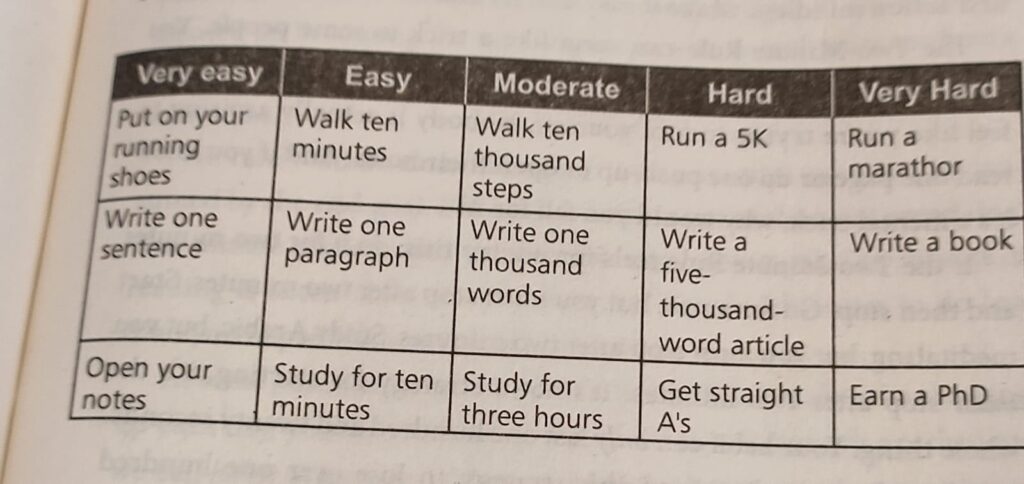
For instance, if you are a beginner, running a marathon is very hard. Running for 2 hours is hard, and walking ten thousand steps is moderately difficult. While walking ten minutes is easy, putting on your running shoes is the easiest. Your ultimate goal is to run a marathon, but your gateway to habit is to put on your running shoes. That’s how you follow the two-minute rule.
Habit Tracker
Habit Tracker is a simple way to measure whether you did a habit, like marking an X on a calendar. The visual forms of measurement make your habits satisfying by providing clear evidence of your progress. One of the most satisfying feelings in life is the feeling of making progress. Always try to keep your habits streak alive, and yes, don’t break the chain. However, in this data-driven world, people tend to get obsessed with measurement devices. So don’t focus just on measurement, but focus on implementation.
The Truth about Talent
This is another concept of James Clear Atomic Habits summary. As per this concept, the secret to maximizing your odds of success is to choose the right field of competition. Pick the right habit, and the progress is easy; pick the wrong habit, and life is a struggle. Habits are easier when they align with your natural abilities. So choose the habits that best suit you. As the author rightly mentions
“Play a game that favors your strengths. If you can’t find a game that favors you, create one.”
Goldilocks Rule
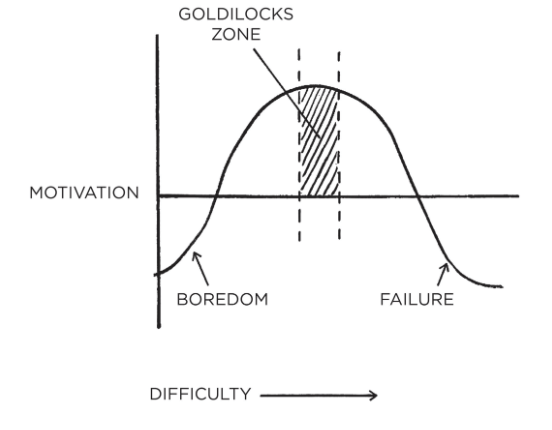
Another awesome rule shared in this self-help book is the Goldilocks Rule. The Goldilocks rule states that humans experience pick motivation while working on tasks that are on the edge of their current abilities. Not too hard, not too easy, just right.
When you start a new habit, it’s important to keep the behavior as easy as possible so that you can stick with it even when the conditions are not perfect. However, once the habit has been established, it is important to continue to advance in small ways. These little improvements and new challenges will keep you engaged. And if you hit the Goldilocks zone, you can achieve the flow state & keep advancing.
Habits + Deliberate Practice = Mastery
This section from Atomic Habits is truly a masterpiece. To achieve mastery, you narrow your focus to one small element of success, repeat it consistently until you master it, and then use that habit as a foundation to reach the next level of growth.
Tasks you do consistently become easier over a period of time, but it does not get easier overall because you are now putting all your efforts and energy into the next challenge. Each habit unlocks the next level of performance. It is an endless cycle.
Final Thoughts
Many people believe success requires a massive transformation, but Atomic Habits by James Clear shows that real change stems from small, consistent improvements. These daily 1% gains compound over time, eventually tipping the scale in your favor. Clear illustrates this with stories of athletes, entrepreneurs, and artists who reached the top by committing to tiny, sustainable habits. Success isn’t a destination—it’s a system you refine every day.
Whether it’s building a business, learning, training, or nurturing relationships, progress comes from not giving up. Small habits don’t just add up—they compound. That’s the power of Atomic Habits.. That wraps up the Atomic Habits book review. I hope you found it insightful and are inspired to apply its powerful concepts in your everyday life.”